
The global democratic coalition supporting Kyiv has focused on what it should not do in the invasion of Ukraine. Its main aims include not letting Ukraine lose and not letting Russian President Vladimir Putin win—but also not allowing the war to escalate to a point where Russia attacks a NATO country or conducts a nuclear strike. More than seven months into the war, the United States and Europe still lack a positive vision for Ukraine’s future.
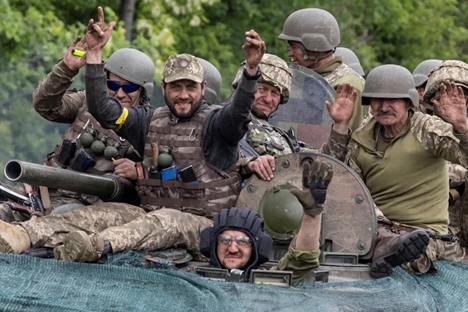 The West believes Kyiv’s fight is just, and wants Ukraine to succeed. But it is not sure yet whether Ukraine is strong enough to retake all its territory. Many Western leaders still believe that the Russian military is too large to be defeated.
Ukraine has proved again and again that it is capable of routing Russia. It first did so by preventing Russia from seizing Kyiv, Kharkiv, Chernihiv, Sumy, and the Black Sea coastline. It succeeded again by halting Russia’s concentrated offensive in the Donbas, the eastern Ukrainian region comprising Donetsk and Luhansk Provinces, part of which Russia has occupied since 2014. Most recently, Ukraine retook Kharkiv Province in less than a week, broke through Russia’s defensive lines in the south, and began liberating parts of the east.
Many Western observers believe Ukraine will have to cede territory to Russia if it wants peace. They are wrong; territorial gains will only embolden the Kremlin. Putin decided to attack eastern Ukraine in 2014 because he succeeded in occupying Crimea. He invaded the entire country because he managed to establish proxy puppet regimes in the Donbas. Partial success motivates Putin to continue his campaigns and seize more territory. The only way to stop the war and deter future aggression is for the invasion to end with an unequivocal Russian failure.
Ukraine’s repeat successes are not coincidences. The country’s military has structural advantages over its Russian adversary. The Russian military is extremely hierarchical and overly centralized; its officers cannot make critical decisions without permission from senior leaders. Ukraine, by contrast, is quick to adapt, with a NATO-style “mission command” system that encourages lower-ranking officers and sergeants to make decisions. Ukraine has also carried out many successful multidirectional attacks.
Ukraine’s advantages are unlikely to dissipate. The Russian military continues to make unsound decisions. A critical number of junior Russian officers were killed in the war’s first months; without them, Russia will find it harder to organize and train its troops. Unlike Ukraine, Russia does not have a strong core of noncommissioned officers who can help with the war.
Russia, indeed has more weapons than Ukraine. Despite months of losses, Moscow still possesses sizable stockpiles of missiles, guns, and ammunition that it can use to attack Ukrainian forces. But this is not the advantage that it may seem. Regarding using weapons, Russia and Ukraine follow different philosophies: Ukraine focuses on high-tech and precision-driven equipment, whereas Russia relies on high-quantity but lower-precision systems.
Putin’s regime will be endangered if Ukraine retakes just the areas Russia seized after February 24. Losing almost all the land it just annexed would be a humiliating failure for Moscow. It may get Russia’s elites to finally realize that their president’s obsession with war is deeply unproductive and will rise against him. It would not be the first time a leader has been pushed out of power in Russian history. Once Putin is gone, the world must focus on making Russia pay restitution.
Putin’s commitment to eliminating Ukraine and forcing it back into his empire is so extreme that a Ukrainian victory cannot be secure as long as he is in power. And Russia is full of ruthless leaders with a similarly distorted moral compass and an equally imperialistic worldview. Until Ukraine is allowed to join NATO, it will have to build a powerful military, becoming a “big Israel.” This is not ideal, and it will be costly. But at least in the near term, it will be the only way a victorious Ukraine can ensure long-lasting peace.
https://www.foreignaffairs.com/ukraine/ukraines-path-victory