
UKRAINE will be in a position to force Russian forces out of the occupied Crimea region in a final blow to Vladimir Putin, according to a former US general. Lt Gen Ben Hodges told Sun Online how the Ukrainians are gathering “irresistible momentum” as they reclaim territory captured early in the war by Putin. 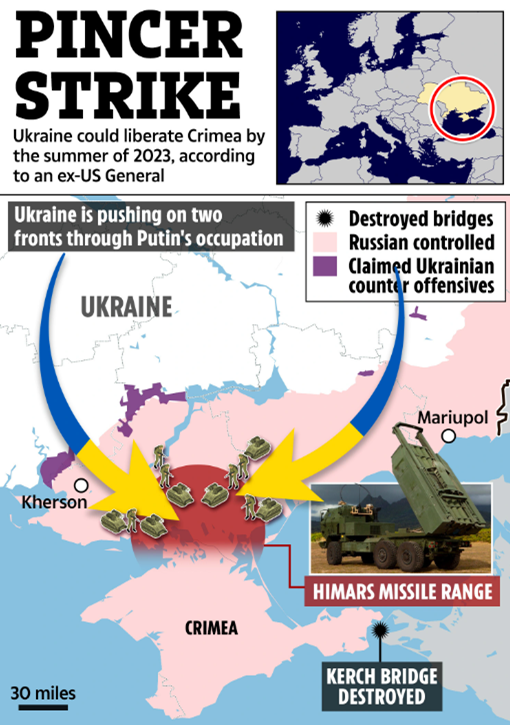
While the Russians have suffered defeat after defeat across the front line, they are now forced to bolster their military with hastily mobilized conscripts who are little more than cannon fodder in a modern war.
General Hodges believes that the Kremlin knows that the situation looks bleak, so it is now using a tactic based on a desperate exchange of “bodies for time” while hoping that both the West and Ukraine succumb to war fatigue. But the reality is that facing the highly motivated Ukrainian forces, the conflict’s pendulum will continue to swing away from Putin.
Losing control of Crimea would be an absolute hammer blow to an already weak Putin after he illegally seized the territory back in 2014.
Widely condemned on the world stage, Putin moved in mysterious unmarked soldiers to remove the Ukrainian authorities before setting up a fake referendum to force the territory to join Russia.
In 2022, Crimea will have been joined by Kherson, Donetsk, Luhansk, and Zaporizhzhia as Russian annexed territory – but the Ukrainians are already pushing back the Russian flax and reclaiming large areas of land.
General Hodges ironically said that “all roads lead to Crimea” when he predicted that the Ukrainians would have retaken Crimea by the summer of 2023.
Putin faces total humiliation if the war ends with him losing all ground to Ukraine.
General Hodges previously served as the commander of the United States Army in Europe.
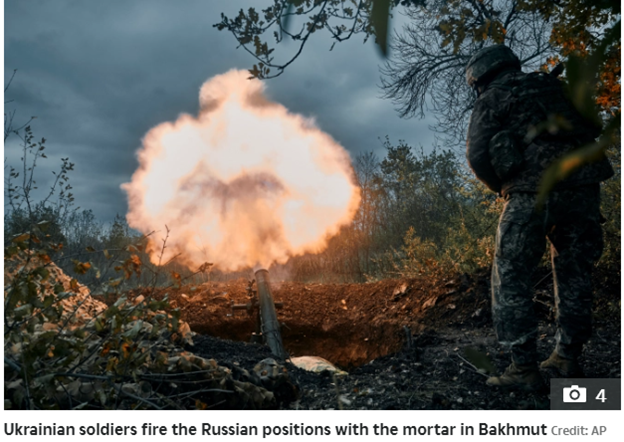
With the two current Ukrainian counter-offensives pushing forward in the south and east, they will eventually push forward to Crimea.
“If you imagine from a Ukrainian perspective, you have the left wing of this offensive coming down from Kharkiv through Donetsk and Luhansk,”
“And then you have the right wing, which has operated very methodically through Kherson.” Kherson has seen some of the heaviest fightings of the war, with Ukraine predicting the “heaviest fighting” is yet to begin but coming around the city, once home to 300,000.
Russian forces are retreating around the area, evacuating civilians with them – with fears that Putin might do something stupid like blow up a key dam. General Hodges said that taking back control of Kherson would be an important “psychological and morale” boost for Ukrainians – but it would also be a major victory on the road to Crimea.
That would then allow the Ukrainians to use US-made HIMARS missiles – which have a launch range of about 80km – within the range of Crimea. From here, Ukraine can directly attack important Russian air bases and supply depots in Crimea and further complicate any attempt by Putin’s troops to fight back.
“Once they get the opportunity to attack Russian targets in Crimea, those places will be impossible to resupply and sustain in the long term,” General Hodges said.
The liberation of Kherson would also mean that the Russians would likely have to leave behind a significant amount of heavy equipment, as the Ukrainians have destroyed all bridges over the Dnipro River. Taking control of Kherson and the Dnipro River would allow the Ukrainians to take control of the Northern Crimea Canal, which supplies water to occupied Crimea.
And that will mean that the Ukrainians with control of the west bank of the Dnipro river will have a front line that very few forces can hold due to the river’s width. This will conversely mean that the current combat-trained troops can be released and deployed elsewhere during the winter, further increasing Ukraine’s opportunities for breaking through the Russian front line.
And with all this in play, it is very possible that the Ukrainians could recapture Crimea, which was stolen from them eight years ago.
General Hodges believes the Russians are now just trading “bodies for time” as they face a difficult winter in Ukraine.
“The Kremlin sends conscripts before they are properly equipped, trained, and organized,” he told The Sun Online.
“The goal is to stretch these things out and hope that the West’s own internal problems will lead to the EU and the US losing the will to continue supporting Ukraine.
“These missiles and drones that Putin is firing at cities are about breaking our will.
“The idea is that people in the West somehow get tired of seeing bombed-out cities and don’t care about Russia making cities uninhabitable.”
Political researcher Dr. Andreas Umland of Stockholm’s Center for East European Studies also said he believes Putin’s new focus on attacking civilians and infrastructure is a ploy to try to provoke a negotiation for a “forced peace.”
“The goal now is to get Ukraine to negotiate with Russia to get a ceasefire or a peace deal that Putin can present as a victory at home,” said Dr. Surroundings
“It will try to force Kyiv into a compromise and to end the war since the war itself is not going well for Russia.
He added: “Putin’s annexation of the territories has created a stalemate – earlier in the war, you could have imagined a Russian withdrawal, could have worked where they just then claimed they had ‘won.’
“Now they mean these annexations, it’s all or nothing for him. Putin has to win this somehow.”
And that is proving extremely difficult as Russia’s army has proven to be very ineffective on the battlefield – despite being supposed to be one of the largest and best equipped in the world.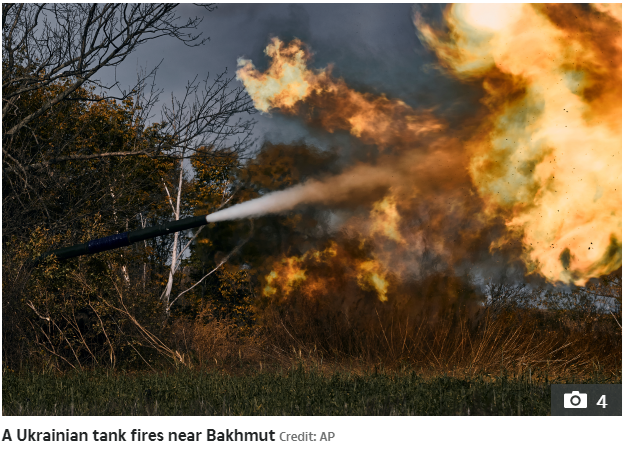
General Hodges admits that he himself “overestimated” the capabilities of the Russians – and said that much of their failure must simply be due to widespread corruption.
“The Russians will, of course, do what it takes; they will find ways to adapt to their many shortcomings – but their problems are deeply rooted in their culture.” Putin’s officers thought they could roll over Ukraine in a matter of days – but now the war has raged for eight months.
They convinced the Russian troops that they would be met with cheers and waving flags as “liberators”, instead, they were confronted with Kalashnikovs and Molotov cocktails as invaders and occupiers.
Putin’s “3-day special operation” has turned into a slow and brutal battle – one where the Ukrainians’ fighting will and skills have forced the Russians to change tactics again and again and, due to the increasingly fewer trained soldiers, to shift the focus from modern attempts to surgical attacks to savage, indiscriminate attacks on civilians.
With further defeats on the horizon, a seemingly hopeless mass mobilization, and a resurgent Ukraine charging towards the Russians’ new “territory,” – the likelihood of the war ending in a complete loss for Putin is growing.
Source: https://www.thesun.co.uk/news/20231126/ukraine-crimea-2023-us-general/